


On the occasion of Hung Kings’ Commemoration Day, the Da Nang Museum of Cham Sculpture will welcome visitors with complimentary admission on April 26, 2026.
Amid the vibrant rhythm of April’s holiday season when many journeys gravitate toward the coast and festive развлечments the museum presents a contrasting experience: one that is quieter, more contemplative, and gently invites a slower, more reflective pace.
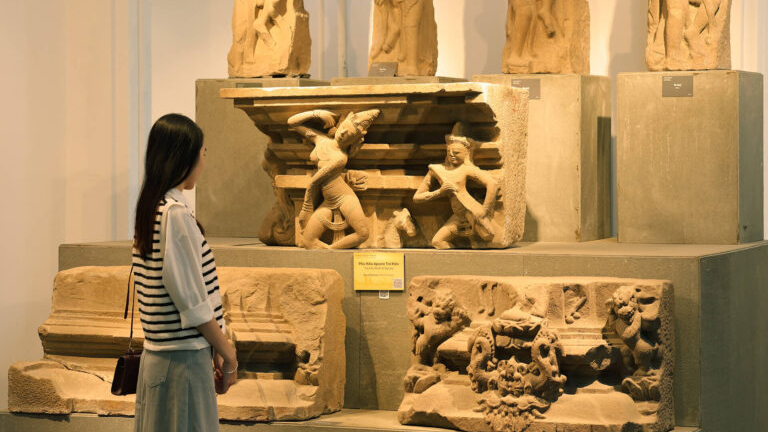
More than a repository of artifacts, the museum unfolds as a narrative space where each object serves as a fragment of history. It currently preserves 12 of Da Nang’s 19 national treasures, alongside one of the world’s most significant collections of Cham sculpture, dating from the 5th to the 15th century. These seemingly silent sandstone works encapsulate a vivid cultural universe, where art, spirituality, and daily life are intricately interwoven in every carved detail.
Through statues of deities, reliefs, and sacred iconography, the profound influence of Hinduism becomes evident not merely as a system of belief, but as a philosophical and aesthetic framework. Here, the divine is not distant from human existence; rather, it is deeply connected to the cosmic order, to systems of faith, and to rituals that once defined the flourishing Champa civilization. At the same time, details in form, attire, and ornamental motifs reveal a sophisticated and cosmopolitan society, shaped by its active participation in ancient maritime trade networks that linked the region to other cultures.
A visit to the museum is not about moving swiftly from one gallery to another, but about lingering pausing to observe, to reflect, and to fully engage with the presence of each piece. It is within these moments of stillness that the experience becomes most meaningful.
On this commemorative day when journeys often carry a deeper sense of returning to one’s roots a visit to the museum offers a distinctive highlight. It is an opportunity to go beyond the surface of travel, and to engage more profoundly with the cultural layers that have shaped the identity of this land.